



Lapis . 迹
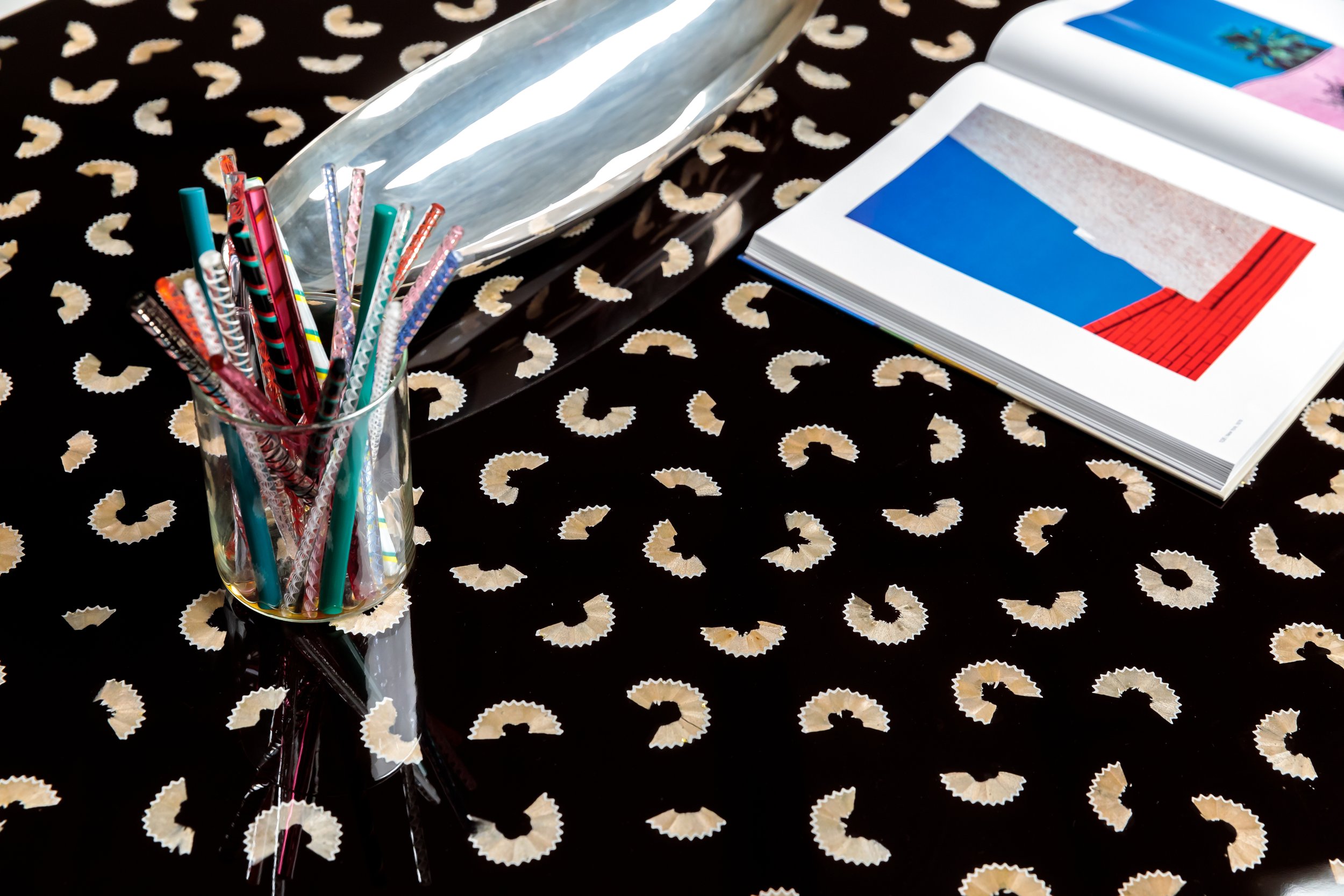
Lapis is a collectible design table made from real pencil shavings, encapsulated within a refined surface of resin and lacquer. More than a functional object, it is a physical manifestation of the design process—an exploration of how ideas are formed, tested, and transformed over time.
Each shaving embedded within the table is a direct trace of creation. Collected, selected, and hand-placed, these fragments represent sketches, iterations, and discarded attempts—moments that are typically hidden but are essential to every creative journey. By preserving them, Lapis reveals a layer of vulnerability and obsession that defines the act of designing.
The piece also reflects the cross-cultural foundation of the studio. The encounter between Luca and Fang’s design sensibilities—shaped by different cultural backgrounds, references, and ways of thinking—becomes a continuous process of dialogue, iteration, and reinterpretation. Innovation emerges not as a singular idea, but as the result of exchange, friction, and refinement. Lapis celebrates this ongoing process, capturing the layered evolution of ideas as they move toward something new.
This duality is further expressed in its Chinese name, “Ji” (迹), meaning “trace” or “mark.” The character encapsulates the essence of the piece: the visible imprint of actions, thoughts, and time. Just as each pencil shaving is a residue of a creative gesture, Ji reflects the accumulation of traces that together form meaning—making it a precise and poetic counterpart to the Latin “Lapis,” which evokes permanence and materiality.
The piece challenges the traditional notion of perfection in design. Rather than presenting a polished and linear outcome, it embraces complexity, imperfection, and experimentation. Failure, repetition, and refinement become visible, turning the surface into a narrative field where process and result coexist.
From a distance, Lapis reads as a minimal, monolithic table with a rich and textured depth. Up close, it becomes unexpectedly intricate—revealing the organic, almost geological composition of pencil shavings suspended in time. This duality creates a dynamic interaction between object and observer, where perception shifts with proximity.
Designed within a framework of warm minimalism, Lapis balances clean geometry with expressive materiality. Its restrained form allows the surface to become the focal point, making it suitable for a variety of contexts including residential interiors, hospitality spaces, galleries, and collectible design exhibitions.
Produced as a limited-edition piece, each Lapis table is inherently unique. Variations in the arrangement, density, and tonality of the pencil shavings ensure that no two pieces are identical, reinforcing its status as a collectible object at the intersection of art and design.
Part of the V10 Gallery collection, Lapis reflects a broader vision to transform original project elements into collectible furniture, offering a wider audience access to the studio’s design language and research.


